

Health Library
Smoking and COPD
Chronic obstructive pulmonary disease - smoking; COPD - secondhand smoke
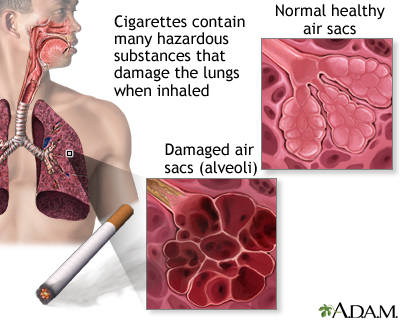
Smoking is the leading cause of chronic obstructive pulmonary disease (COPD). Smoking is also a trigger for COPD flare-ups. Smoking damages the air sacs, airways, and the lining of your lungs. Injured lungs have trouble moving enough air in and out, so it may be hard to breathe.
Images
I Would Like to Learn About:
Information
Things that make COPD symptoms worse are called triggers. Knowing what your triggers are and how to avoid them can help you feel better. Smoking is a trigger for many people who have COPD. Smoking can cause an exacerbation, or flare-up, of your symptoms.
You do not have to be a smoker for smoking to cause harm. Exposure to someone else's smoking (called secondhand smoke) may also be a trigger for COPD flare-ups.
Smoking damages your lungs. When you have COPD and you smoke, your lungs will get damaged more rapidly than if you were to stop smoking.
Quit Smoking
Quitting smoking is the best thing you can do to protect your lungs and keep your COPD symptoms from getting worse. This can help you stay more active, enjoy life, and live longer.
Tell your friends and family about your goal to quit. Take a break from people and situations that make you want to smoke. Keep busy with other things. Take it 1 day at a time.
Ask your health care provider to help you quit. There are many ways to quit smoking, including:
- Medicines
- Nicotine replacement therapy
- Support groups, counseling, or stop-smoking classes in person or online
It is not easy, but anyone can quit. Newer medicines and programs can be very helpful.
List the reasons you want to quit. Then set a quit date. You may need to try quitting more than once. And that's OK. Keep trying if you do not succeed at first. The more times you try to quit, the more likely you are to be successful.
Avoid Secondhand Smoke
Secondhand smoke may trigger COPD flare-ups and cause more damage to your lungs. So you need to take steps to avoid secondhand smoke.
- Make your home and car smoke-free zones. Tell others you are with to follow this rule. Take ashtrays out of your home.
- Choose smoke-free restaurants, bars, and workplaces (if possible).
- Avoid public places that allow smoking.
Setting these rules can:
- Reduce the amount of secondhand smoke you and your family breathe in
- Help you quit smoking and stay smoke-free
If there are smokers at your workplace, ask someone about policies regarding if and where smoking is allowed. Tips to help with secondhand smoke at work are:
- Make sure there are proper containers for smokers to throw away their cigarette butts and matches.
- Ask coworkers who smoke to keep their coats away from work areas.
- Use a fan and keep windows open, if possible.
- Use an alternative exit to avoid smokers outside the building.
References
Global Initiative for Chronic Obstructive Lung Disease (GOLD) website. Global strategy for prevention, diagnosis and management of COPD: 2026 Report. goldcopd.org/2026-gold-report-and-pocket-guide/. Accessed January 15, 2026.
Han MK, Lazarus SC. COPD: diagnosis and management. In: Broaddus VC, Ernst JD, King TE, et al, eds. Murray and Nadel's Textbook of Respiratory Medicine. 7th ed. Philadelphia, PA: Elsevier; 2022:chap 64.
Reilly J. Chronic obstructive pulmonary disease. In: Goldman L, Cooney KA, eds. Goldman-Cecil Medicine. 27th ed. Philadelphia, PA: Elsevier; 2024:chap 76.
Rochester CL, Nici L. Pulmonary rehabilitation. In: Broaddus VC, Ernst JD, King TE, et al, eds. Murray and Nadel's Textbook of Respiratory Medicine. 7th ed. Philadelphia, PA: Elsevier; 2022:chap 139.
BACK TO TOPReview Date: 10/19/2025
Reviewed By: Laura J. Martin, MD, MPH, ABIM Board Certified in Internal Medicine and Hospice and Palliative Medicine, Atlanta, GA. Also reviewed by David C. Dugdale, MD, Medical Director, Brenda Conaway, Editorial Director, and the A.D.A.M. Editorial team.
 | A.D.A.M., Inc. is accredited by URAC, for Health Content Provider (www.urac.org). URAC's accreditation program is an independent audit to verify that A.D.A.M. follows rigorous standards of quality and accountability. A.D.A.M. is among the first to achieve this important distinction for online health information and services. Learn more about A.D.A.M.'s editorial policy, editorial process and privacy policy. A.D.A.M. is also a founding member of Hi-Ethics. This site complies with the HONcode standard for trustworthy health information: verify here. |
The information provided herein should not be used during any medical emergency or for the diagnosis or treatment of any medical condition. A licensed medical professional should be consulted for diagnosis and treatment of any and all medical conditions. Links to other sites are provided for information only -- they do not constitute endorsements of those other sites. No warranty of any kind, either expressed or implied, is made as to the accuracy, reliability, timeliness, or correctness of any translations made by a third-party service of the information provided herein into any other language.
© 1997-
2026 A.D.A.M., a business unit of Ebix, Inc. Any duplication or distribution of the information contained herein is strictly prohibited.
All content on this site including text, images, graphics, audio, video, data, metadata, and compilations is protected by copyright and other intellectual property laws. You may view the content for personal, noncommercial use. Any other use requires prior written consent from Ebix. You may not copy, reproduce, distribute, transmit, display, publish, reverse-engineer, adapt, modify, store beyond ordinary browser caching, index, mine, scrape, or create derivative works from this content. You may not use automated tools to access or extract content, including to create embeddings, vectors, datasets, or indexes for retrieval systems. Use of any content for training, fine-tuning, calibrating, testing, evaluating, or improving AI systems of any kind is prohibited without express written consent. This includes large language models, machine learning models, neural networks, generative systems, retrieval-augmented systems, and any software that ingests content to produce outputs. Any unauthorized use of the content including AI-related use is a violation of our rights and may result in legal action, damages, and statutory penalties to the fullest extent permitted by law. Ebix reserves the right to enforce its rights through legal, technological, and contractual measures.
